News
IB vs IGCSE vs British Curriculum: Parent Guide | Lexora
IB vs IGCSE vs British Curriculum: What Should Parents Know Before Choosing?
With increasing academic competition, choosing the right curricula has become a significant decision for parents to make. And in Dubai with IB, IGCSE, British, and a multitude of other options, it can be difficult to navigate.
When comparing curriculums, then it really comes down to those four things: how quickly does a student learn, what grade they are currently in, whether or not the family plans to move, and what their future goals are? But there is no one "best" curriculum. What works well for one child may not work well for another.
Whether it is a specific learning style, the fact that your child is academically more inclined to focus on a few subjects or a decision to be able to stay longer at school, it all plays a role. This guide offers a brief overview of IB vs IGCSE vs British curriculum, which helps you make the right decision and ask the right questions.
IB, IGCSE and British Curriculum at a Glance: Overview
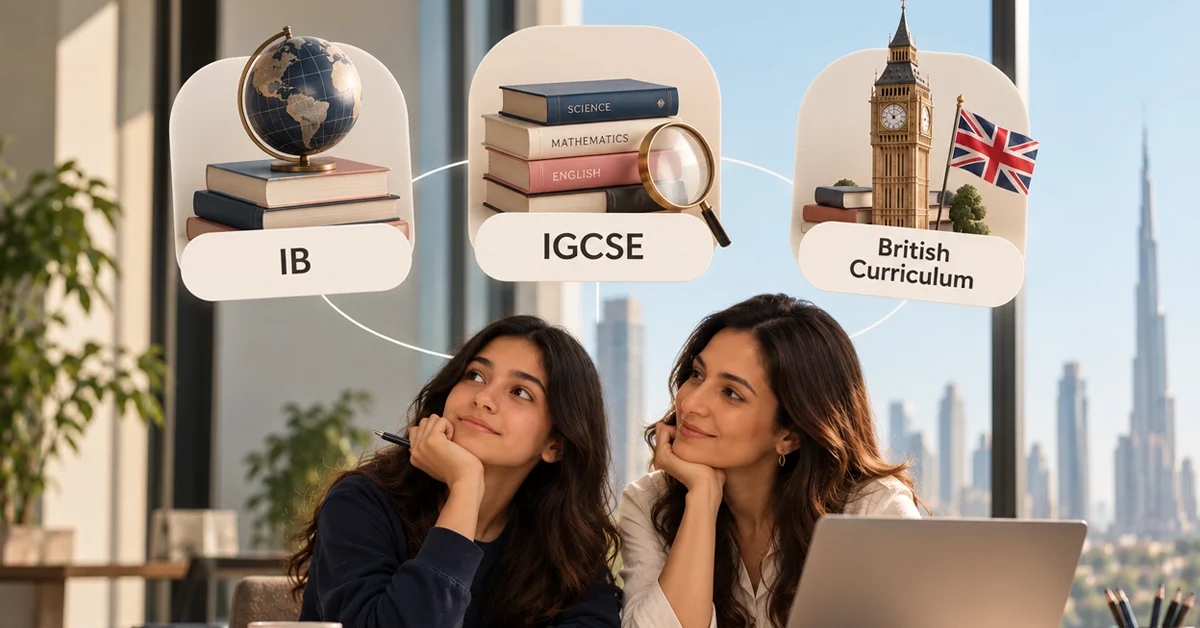
A comprehensive explanation of IB vs IGCSE vs British curriculum lets us understand the terminology, as each of these doesn't sit at the same level:
British curriculum
It refers to a broader framework of the English National Curriculum, which is the curriculum followed with variation by British-curriculum schools across the globe.
It covers the period from early years (EYFS) to primary and secondary school, typically ending in GCSEs or IGCSEs, and then A-Levels or BTECs.
IGCSE (International General Certificate of Secondary Education)
It's not a curriculum on its own; it is the international qualification most British-curriculum schools take in the secondary years (ages 10-11 and 14-16) instead of the UK's GCSE. It is awarded by the exam bodies Cambridge International or Pearson Edexcel.
IB (International Baccalaureate)
IB curricula is an independent curriculum framework, developed by the International Baccalaureate, an international education organisation. It usually works with its own philosophy, format and assessment style, offered in four programmes for various age ranges.
Therefore, the best way of putting it is the British Curriculum with IGCSE as the secondary-stage qualification vs. the IB programme. Whereas, it’s worth knowing that IGCSE differs from school to school, depending upon which exam board and what combinations of subjects are available.
IB vs IGCSE vs British Curriculum: Key Differences
A comparison table is presented distinguishing, IB; IGCSE; British curriculum. These are differentiated across different factors:
Feature | IB | IGCSE and British Curriculum |
Structure | Four programmes by age group:
| Continuous stages: EYFS Primary to KS3 IGCSE (Years 10 to 11) A-Levels (Years 12 to 13) |
Subject choice | Broad and compulsory across subject groups, sciences, humanities, languages, arts, etc., with less early specialisation. | Some flexibility at IGCSE; strong specialisation later, since A-Level students typically choose just 3 to 4 subjects |
Assessment style | Continuous, inquiry-based assessment plus final exams; includes coursework like the Extended Essay and CAS at Diploma level. | Primarily exam-based, with standardised external exams (Cambridge, Edexcel, AQA, etc.) at set points. |
Teaching & learning style | Inquiry-led, interdisciplinary, focused on critical thinking and independent research. | Structured, subject-based teaching with a clear syllabus and defined content to cover. |
Breadth vs depth | Broader spread of subjects held for longer, encouraging generalist thinking. | Earlier specialisation, allowing deeper focus on fewer subjects by Sixth Form. |
Progression | Designed as one continuous philosophy from PYP to DP, though schools may only offer some programmes. | Clear, familiar staged progression (GCSEs then A-Levels), widely recognised by UK and international universities. |
IB Curriculum
The IB (International Baccalaureate) is an internationally recognised organisation. Its educational programmes are for students from age 3 to 19, the IB encourages active and enquiry based learning rather than simple memorisation.
IB education is divided into four programmes:
PYP (Primary Year Programme): The PYP (3 – 12 years) focuses on inquiry through global and local issues while examining transdisciplinary themes, without dividing them into all the separate subject blocks.
MYP (Middle Years Programme): 11 to 16 years, in-between the subject centres, providing for increased integration and transdisciplinary possibility.
DP (Diploma Programme): 16-19 years of age; it is one of the most popular levels. Students take 6 courses from different areas and work on the extended essay, Theory of Knowledge and CAS (Creativity, activity and service).
CE (Career-related Programme): 16-19 years, a more vocational route than the DP, offering a combination of academic studies and career-related subjects.
Here's what parents need to know about the IB programme:
Inquiry-Based and Student-Centred Learning
IB school encourages students to ask questions, explore ideas and be active learners. Instead of memorising facts to pass tests.
Prioritise Critical Thinking and Practical Comprehension
The curriculum emphasises children examining and evaluating a range of information. This helps children move beyond learning an answer towards understanding how and why it works.
Different Programmes for Different Age Groups
The IB Curriculum takes place in 4 programmes. Parents should check which programme their child’s school offers, as the curriculum structure, subjects, learning expectations and assessment approach differ between programmes.
Learning Connects Across Disciplines and the Real World
IB programmes inspire students to draw links across various subjects and disciplines rather than teach every part of our lives separately.
School Implementation Matters
Not all schools can offer all IB programmes, and schools need to be authorised to deliver each. It is worth checking these before you choose a school, along with the support options available to students.
IGCSE and British Curriculum
The IGCSE is embedded in the British pathway, rather than beside it. The qualification of most British-curriculum schools is used at the end of Key Stage 4 (Year 10-11), replacing the UK's standard GCSE for international schools.
However, there are some points of variation that parents should know about:
Different exam boards - The school either offers Cambridge International, Pearson Edexcel, or other exam boards. The syllabus content, grading scale and the pattern of examinations may differ between boards across the same subject.
Subject Combination - Two British-curriculum schools have notably different subject lists at IGCSE level, particularly in core elective subjects such as business, computer science or additional languages.
A-Level pathway - you do 3-4 subjects in Year 12 and 13 (after your IGCSEs), and this is what you would then use to apply to university with most UK universities but also all around the world.
British curriculum isn't one-size-fits-all - Many schools have the flexibility to adapt their interpretation of the National Curriculum framework on an international basis. It is safer to ask a particular school how devoted they are to the curriculum rather than think that all British-curriculum schools teach the same things.
Which Curriculum May Suit Different Learners?
Every child learns in their own unique way, so which curriculum is ideal will depend on how your child studies, thinks, and remains inspired.
The following circumstances will help your decision:
The child who prefers structure and simple exam targets is likely to find the progression through the syllabus of the British or IGCSE pathway more reassuring for them to settle into.
Whereas, child comfortable with open-ended enquiries and conversation and who makes connections between subject matter would thrive in the IB's inquiry-based learning approach, notably at PYP and MYP.
A student who is aware of their strengths and decides on a career early would choose A-Level courses.
Students seeking to leave their options open later on may like the wider spread of subjects available in six groups as part of the IB Diploma.
A family preparing to relocate might also appreciate the IB's consistency between its schools worldwide or a familiar British curriculum.
Family planning for UK university admission may be more straightforward with a familiar system like GCSEs/A-Levels, but IB Diploma students do also apply to the UK.
These are just guidelines, not cast-in-stone rules; many students excel in either system. The best indication of how well suited a child is to the curriculum is by assessing the manner in which your child already learns and works.
What UAE Parents Should Check Before Choosing a Curriculum
A list of considerations is mentioned which parents should check before settling on a curriculum.
What the school offers
Confirm the exact curriculum of the school and exam board (for IGCSE schools) or IB programme (PYP/MYP/DP/CP) the school uses. Don’t assume on genre labels like British schools.
Current age of child and the stage
Select a curriculum that suits your child's age and stage of education. Look at the progression between years, key transition points and if the school has a clear route through secondary education.
School and KHDA Information Dubai
Look for KHDA information, inspection reports, fees, and curriculum info. See the education authority in the emirate and the school's information; before deciding on a school for your child, get every relevant detail.
Assessment Route
Pay particular attention to the examination path: topics needed, choice options for specific subjects, assessment criteria, coursework/project/internal assessment, standards and grading system.
University Expectations
If you already have a country or type of university in mind, check entry requirements for both the IB and A-Level/IGCSE routes directly with target universities. Ensure IB, British, and IGCSE subjects and grades align with entry requirements of UAE universities and other potential options.
Conclusion
At the end there's no "best" curriculum; IB, IGCSE and the British system work well, but for different types of learners. If your child prefers straightforward rules, fixed subjects and exams, then the British/IGCSE route is more likely to be a good fit.
For a curious student who loved to question, ideate, and think independently, the IB may be more suitable. Here's how to decide: go and see schools, check out the KHDA rating and ask honest questions about the methods of teaching.
We at Lexora Institute are here to support parents through this process and guide them every step of the way.
Frequently Asked Questions (FAQs)
Q1. Which is better, IB or IGCSE?
Neither is inherently better; it is whether one is better able to equip your child to meet their style of learning, which one is right for your school, and which one more properly meets your child's educational strategies.
Q2. Is IB harder than IGCSE?
It's different for everyone; IB has longer, more personal work and more subjects. IGCSE exams are based on which one you're good at.
Q3. How is IB different from IGCSE?
IB is a school-wide programme with an inquiry-based curriculum and continuous assessment with 4 programmes. IGCSE is a competitive qualification at the British secondary education level, and it's exam-based.
Q4. How are the IGCSE and the British curriculum different?
IGCSE is usually an award as part of a larger British model route, not a curriculum in its own right. School course names, exam boards and terminology vary from place to place, so be sure to double-check!
Q5. Can I choose the Dubai curriculum for my child?
There is no right or wrong; consider your child’s learning style, how the school implements learning models, and the KHDA rating. Also factor in if your child's future objective is supported by the curriculum or not.
Q6. Can students move between curricula?
Yes, you can change. However, this will depend on your child's age, what the compatibility check reveals, what gaps you have in your choice of curriculum and what the receiving school requires; it is worth clarifying with the receiving school.
Published:
Other Publications