News
How Chemistry Tutoring Helps with Organic Chemistry
See how one-on-one chemistry tutoring helps students overcome organic chemistry struggles, build understanding, and improve grades.
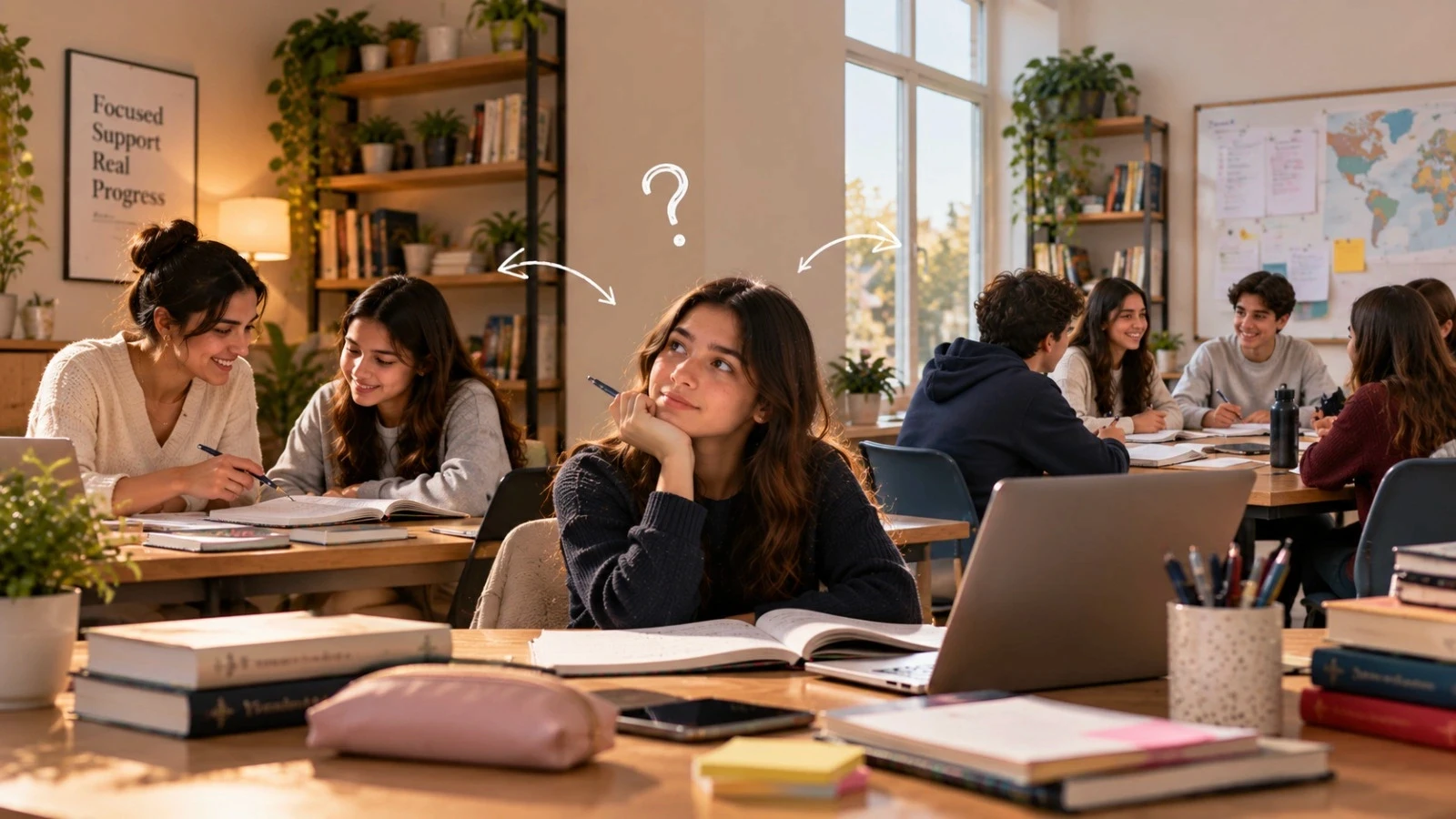
Ask an A-Level or IB Chemistry student in Dubai which unit cost them the most marks and organic comes up more than anything else. Not because there is more of it, although there is. Because it changes the rules mid-course.
Up to IGCSE, chemistry mostly rewards recall. Name the homologous series, learn the test for an alkene, memorise the products. Then Year 12 arrives and a paper asks students to predict what an unfamiliar molecule will do, with curly arrows to justify it. Nobody taught them to think that way, so they revise harder and still lose the marks.
Below: why organic breaks otherwise strong students, what one-to-one tutoring does about it, and how to tell whether your child needs it.
Quick answer: how chemistry tutoring helps with organic chemistry
Chemistry tutoring helps students struggling with organic chemistry by breaking reaction mechanisms into step-by-step logic, drilling the specific reaction types the student keeps losing marks on, and building the 3D thinking that stereochemistry questions demand. A tutor also traces the problem back to its source, usually a gap in bonding, electronegativity or electron movement from an earlier year. That diagnosis is close to impossible in a class of thirty.
Why organic chemistry is so difficult for many students
It is not just memorisation
Students arrive at organic expecting a memory task, and for a few weeks that works. Then a question hands them a molecule they have never seen and asks what a named reagent does to it. Recall cannot answer that. They need to know why an electron-rich species attacks an electron-poor carbon: bond polarity, lone pairs, stability of intermediates. Fifty memorised reactions get you through a topic test, not through Paper 2.
The subject is cumulative
Electron pushing is the grammar of the whole course. A student who never grasped it in the alkene unit is still guessing at acyl chlorides, aromatic substitution and every synthesis question in the summer paper.
It demands visual and spatial thinking
Chirality, optical isomers and the inversion in an SN2 reaction all ask students to hold a molecule in three dimensions and rotate it mentally. Plenty of capable students draw flat structures perfectly, then stall the moment a question mentions stereochemistry. The skill is trainable, but someone has to watch them sketch and correct the habit on the spot.
Class sizes limit individual support
None of this is a criticism of school teachers. A teacher with thirty students and a scheme of work to finish before mocks cannot pause for a week because six of them have not grasped curly arrows. The pace belongs to the syllabus, and once the organic window closes the class moves on.
How chemistry tutoring addresses these struggles
Finding and fixing the foundational gap
Good tutoring opens with a diagnostic, not a lesson. Very often the problem is not organic at all. It is electronegativity, lone pairs or bond polarity from Year 10 that never landed. Fix that and half the later confusion clears on its own.
Teaching mechanism-based reasoning
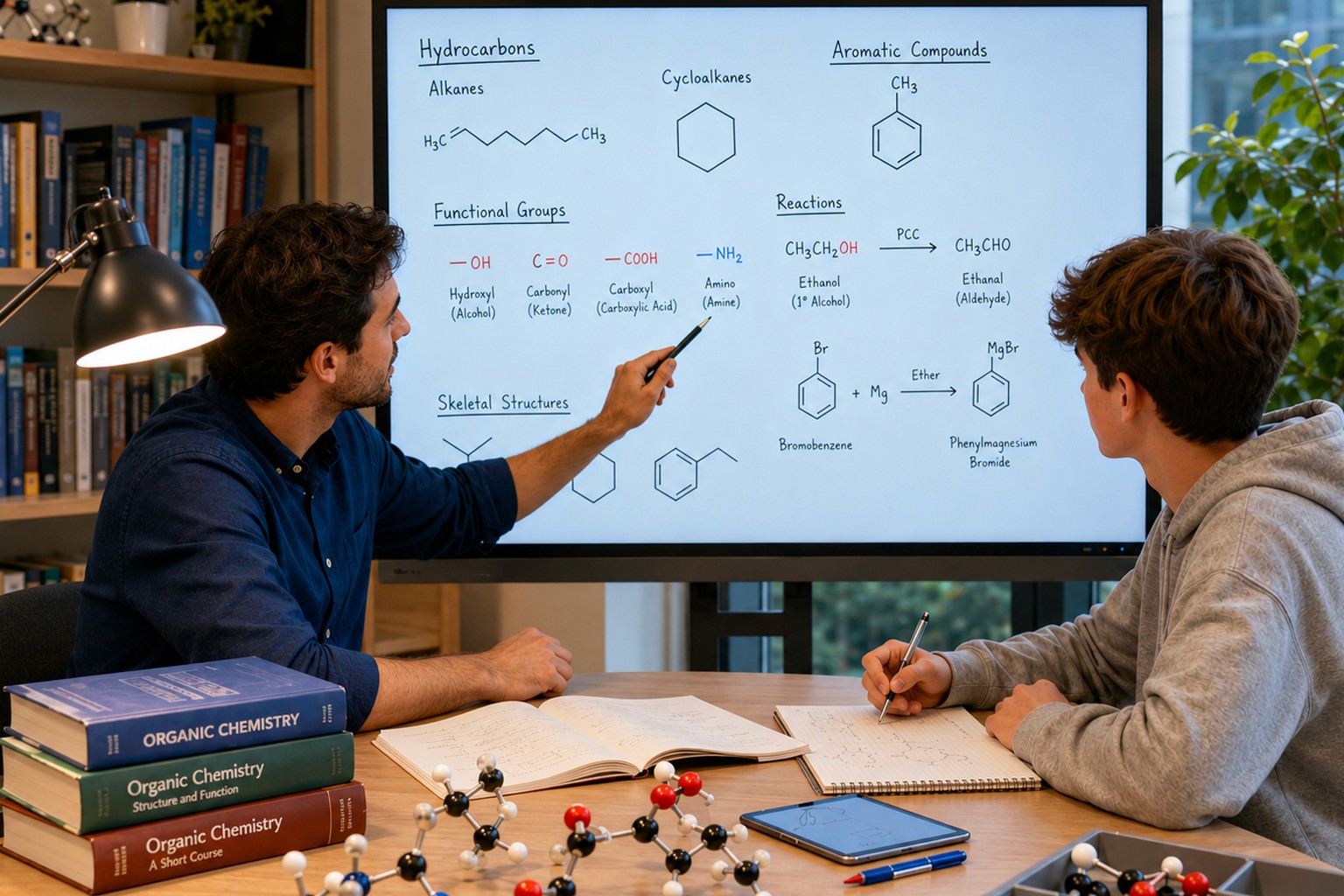
A chemistry tutor in Dubai working one-to-one can teach curly arrows as a language with rules: electrons start somewhere specific, move somewhere specific, and the arrow shows which. Once a student reads a mechanism instead of recognising it, unseen reactions stop being unseen.
Working at the student's pace
If electrophilic addition is the sticking point, a tutor spends three sessions there. If alcohols are solid, that topic gets ten minutes and a check question. No classroom timetable allows that trade.
Practice with varied problem sets
Pattern recognition comes from volume and variety, not re-reading notes. Working one mechanism family across Edexcel, AQA, CIE and IB past papers teaches students to spot the reaction hiding behind unfamiliar wording, and to answer in the language mark schemes reward.
Exam and study strategy
Multi-step synthesis has a technique: work backwards from the target molecule, name the functional group change at each step, then choose reagents. Students who have not drilled it freeze under time pressure. Tutors also teach mark allocation, so nobody writes three paragraphs for two marks.
Room to ask the question they will not ask in class
Sixteen-year-olds will not raise a hand in front of twenty-nine classmates to admit they still cannot tell a nucleophile from an electrophile. One-to-one, they will, usually by week two. That one question often explains a term of lost marks. Benjamin Bloom's 1984 research found individually tutored students outperformed conventionally taught peers by around two standard deviations, and the freedom to admit confusion is much of why.
Classroom learning versus tutoring: what actually differs
Factor | School classroom | One-to-one tutoring |
|---|---|---|
Class size and pace | 25 to 30 students, pace set by the syllabus | One student, pace set by understanding |
Personalisation | One explanation for everyone | Rebuilt until it lands |
Practice volume | Set homework, little marked practice | Targeted sets on weak reaction types |
Feedback speed | Days, sometimes a week | Immediate, mid-problem |
Asking questions | Public, so students stay quiet | Private, so gaps surface early |
What a typical organic chemistry tutoring session looks like
Sessions at Lexora open with a short diagnostic: recent homework, a mock paper, or two questions that expose where the reasoning breaks. Then a concept walkthrough on whatever surfaced, with the student drawing the mechanisms rather than watching someone else draw them.
The middle is guided practice, where the tutor watches the working and interrupts at the error instead of at the end. The last stretch covers what is coming: school assessments, stuck homework, past paper questions matched to their board.
Signs a student would benefit from organic chemistry tutoring
Scores stay low despite real revision hours
They follow the lesson in class but cannot start the question at home
They fell behind after missing a week and never caught up
Marks hold up in physical and inorganic chemistry and only drop in organic
They name reagents and products confidently, then freeze on "explain the mechanism"
Chemistry specifically triggers exam anxiety that other subjects do not
Two or three of these together points to a structural gap, and more revision alone will not close it.
A typical improvement pattern
The example below is a composite of how students commonly progress, not one named student.
A Year 12 boy on Edexcel A-Level Chemistry arrives after a D in his mocks. His recall is fine, functional groups and reagents listed without hesitation. Every mark he drops is on questions containing the word "explain". The diagnostic points backwards, to Year 11 bond polarity he had memorised as a definition and never understood as a behaviour.
Three sessions go back to electronegativity, lone pairs and curly arrow conventions. Weeks four to eight take one mechanism family each, followed by six to eight past paper questions. Weeks nine to twelve move to unseen synthesis under timed conditions. He finishes the term on a B.
One to two grades across a term is a fair expectation for a student who does the homework. Anyone promising more than that in a fortnight is selling something.
FAQs
Why is organic chemistry so hard compared to other chemistry topics?
Physical and inorganic chemistry reward calculation and recall, and both let you recover after a weak topic. Organic asks students to predict how molecules they have never met will behave, using reasoning that builds on every earlier unit. Miss one foundation and everything after it wobbles.
How many tutoring sessions does it take to improve in organic chemistry?
Most students need four to six weekly sessions before the reasoning clicks, and a full term before it shows in school grades. A narrow gap, such as one mechanism family, sometimes takes only two or three.
Is online chemistry tutoring effective for organic chemistry?
It works when the tutor can see the student's working live, through a shared whiteboard or a document camera. Organic is a subject you learn by drawing. Sessions where the student only watches and listens help far less, online or in person.
What should I look for in an organic chemistry tutor?
Ask which exam boards they have taught, whether they teach mechanisms or reaction lists, and how they diagnose the gap before starting. A tutor who begins with an assessment rather than a lesson plan is the safer choice. Curriculum match matters too: IB HL, A-Level and AP treat organic differently.
Can tutoring help with university-level or MCAT-style organic chemistry?
The mechanism-based reasoning transfers directly, and students who learn it properly at A-Level or IB start university a term ahead. Lexora's chemistry tuition is built around school curricula and tests such as the SAT, so for admissions-test preparation, ask about the individual tutor's background first.
Key takeaways
Organic punishes memorisation because exams test unfamiliar molecules, not remembered ones
It is cumulative, so one missed foundation, usually electron pushing, costs marks all year
Tutoring diagnoses that root gap first, then teaches mechanisms as logic rather than lists
Practice across exam boards builds the pattern recognition timed synthesis questions demand
A term of weekly sessions typically moves a committed student one to two grades
Struggling with organic chemistry?
Lexora Institute is a KHDA-licensed tutoring centre on Al Wasl Road in Jumeirah 1, supporting British, IB and American curriculum students across Jumeirah, Al Safa, Umm Suqeim and Al Wasl. Every student starts with a free diagnostic assessment, so you know where the gap sits before committing.
Book a free assessment with a chemistry tutor
Written by the academic team at Lexora Institute, Jumeirah 1, Dubai.
Published:
Other Publications